

WEEK 7
Responsible AI, Guardrails & Deployment


A safer assistant, deployed to a public link
Course Details
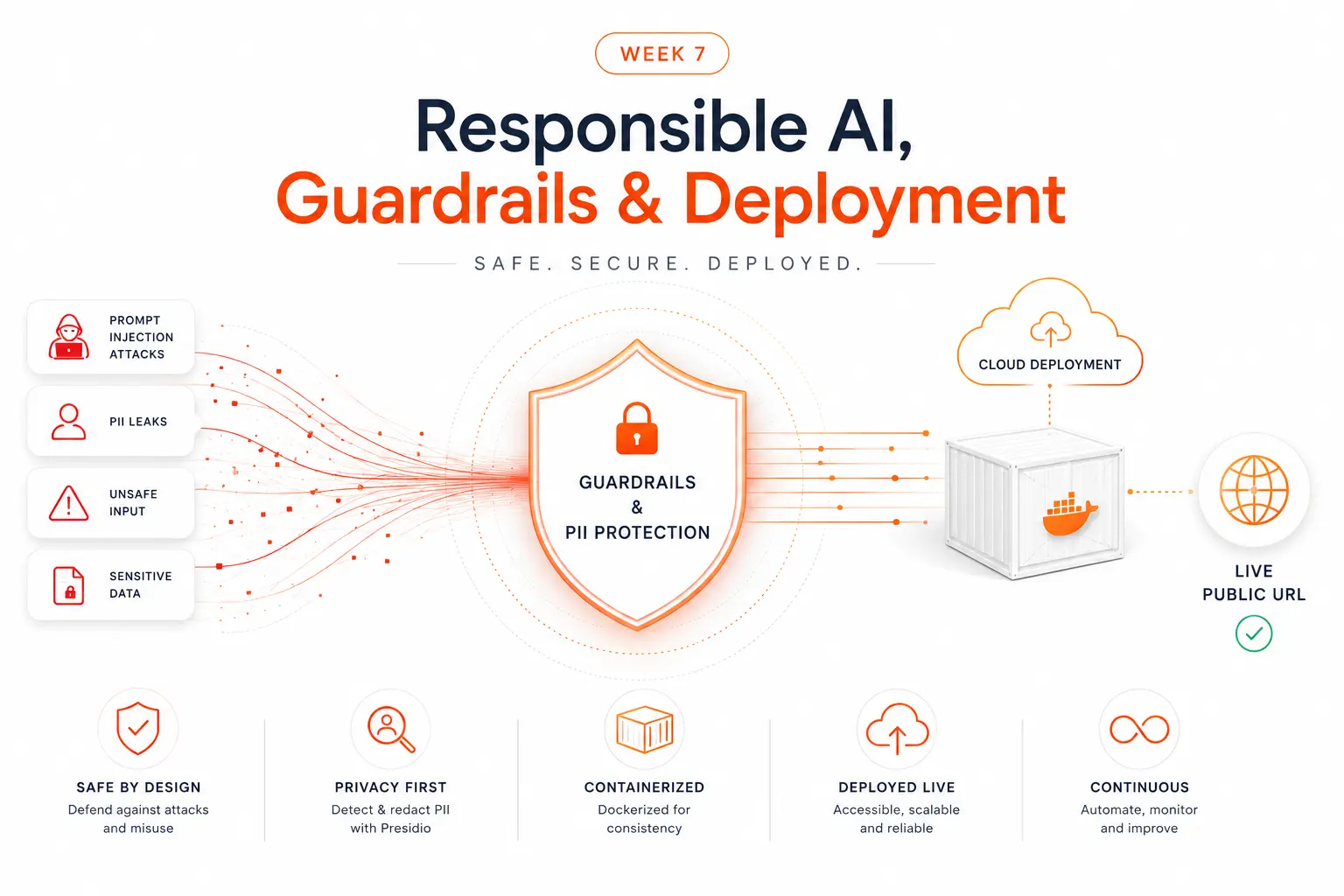
Students learn how to build AI systems that are safe, secure, and production-ready. They implement guardrails against prompt injection, detect and redact sensitive information using Microsoft Presidio, containerize AI applications with Docker, and deploy them to a live public endpoint. By the end of the week, students move from local prototypes to secure, deployable AI services.
WHAT YOU'LL LEARN
Prompt injection attacks & defence
PII detection & redaction (Presidio)
A practical responsible-AI checklist
Docker for AI services
Deploying to a public URL
Topics Covered
Microsoft Presidio
Docker
GitHub Actions
Cloud Deploy
Project 7
GuardianAI · DeployGuard
Project 1: GuardianAI
Project Description
Build a secure AI assistant that protects against prompt injection attacks and prevents sensitive information from being exposed. Students implement input validation, guardrails, PII detection and redaction with Microsoft Presidio, and responsible AI safeguards to create a safer production-ready assistant.
Project Result
Developed a secure AI assistant with built-in guardrails for prompt injection defense and automatic PII detection and redaction. Implemented responsible AI best practices to ensure safer interactions while protecting sensitive user data before it reaches the language model.
Project 2: DeployGuard
Project Description
Containerize the AI assistant using Docker and deploy it to a public cloud environment. Students build a production-ready deployment pipeline, configure cloud hosting, and automate deployment using GitHub Actions to make their AI service securely accessible through a live URL.
Project Result
Built and deployed a production-ready AI assistant using Docker and cloud infrastructure with automated deployment through GitHub Actions. Delivered a secure, publicly accessible AI service featuring containerization, continuous deployment, and production deployment best practices.


Back to Home